
Good Friday: Behold The Man - The Suffering, The Love, & Victory Of Jesus Christ


There are moments in Scripture that are meant to be studied, and there are moments that are meant to be felt. The final hours of Jesus' life draw us into something deeper than information; they invite us into encounter. If we allow ourselves to slow down, to sit in the weight of what truly happened, we begin to realize this is not just a historical account, but a deeply personal reality unfolding before us. This is where eternity intersects with humanity, where divine love steps fully into human suffering, not to avoid it, but to redeem through it. Jesus was not swept into these events unwillingly; every step was intentional, every moment embraced with full awareness of teh cost. And when we truly see that, the cross is no longer distant, it becomes intimately connected to our own lives, our own failures, and our own desperate need for Grace and Mercy.

The Arrest: Love That Did Not Resist
In the quiet darkness of the garden, there is a sacred stillness that is suddenly interrupted by the sound of footsteps, armor, and betrayal. Jesus, fully aware of what was about to unfold, did not hide or retreat. instead, He stepped forward into the moment, meeting those who came to seize Him with a calm authority that reveals His complete control over the situation.
When Judas approached and kissed Him, it was not just an act of betrayal, it was the distortion of closeness into treachery, a moment that must have cut deeply on a human level. And yet, Jesus responded not with anger or rejection, but with a composure rooted in love and purpose.
Even when Peter, driven by emotion and loyalty, attempted to defend Him with a sword, Jesus topped him, making it clear that this path was not one of resistance, but of surrender to the Father's will. What we witness here is not weakness, it is strength under control. It is love choosing not to fight back, even when it has every right to. And in this moment, we are confronted with a Savior who willingly walked into suffering, not because He had to, but because He desired to redeem us.

The False Trial: Truth Condemned By Lies
The trial of Jesus is one of the most profound displays of injustice in all of history. He stood before religious leaders, men who were entrusted with upholding truth, yet instead, they actively sought false testimony in order to justify a predeterminied sentence of death.
The atmosphere was charged with accusation, manipulation, and spiritual blindness. Witness after witness came forward, their words inconsistent and unreliable, yet the outcome remained unchanged because the verdict had already been decided in the hearts of those in power. Yet, Jesus remained silent. That silence is one of the most powerful aspects of this moment. He did not argue, defend, or attempt to correct the lies being spoken against him. The One who is Truth incarnate stood in the face of falsehood and allowed Himself to be condemned by it.
This reveals a depth of surrender that is difficult for us to comprehend, especially in a world where we are so quick to defend ourselves, justify our actions, and fight for our own righteousness. Jesus absorbed every false accusation, every misunderstanding, every distortion because He knew that through His silence, He was making a way for us to be justified before God.

Peter's Denial: The Pain Of Human Failure
Peter's denial is one of the most deeply human and relatable moments in the entire narrative. Here was a man who genuinely loved Jesus, who had boldly decalred his willingness to stand by Him no matter the cost. Yet, when the pressure mounted, when the fear gripped his heart and self-preservation took over, his courage faltered.
In the glow of a small fire, surrounded by strangers, Peter denied even knowing the One he had walked so closely with. not once, but three times. And then, in a moment that feels almost unbearable in its emotional weight, Jesus turned and looked at him. That look was not filled with anger or rejection; it was filled with knowing. It was a look that saw Peter fully, in both his devotion and his failture. It broke him. Peter wept bitterly, not just because he had been caught, but because he realized the depth of his own weakness.
This moment resonates so deeply with us because we, too, know what it is to fall short, to shrink back, to fall in moments where we wanted to be faithful. Yet what makes this moment so powerful is that it is not the end of Peter's story. Jesus would later restore him, reminding us that our failures do not disqualify us from His love; they become the very places where His grace meets us most deeply.

The Flagellation: The Brutality Of Roman Scourging
Before Jesus ever reached the Cross, His body endured a level of suffering that is almost beyond comprehension. Roman flagellation was not a simple beating; it was a calculated and brutal act designed to weaken, humiliate, and bring a person to the very edge of death.
Jesus would have been stripped and bound, completely exposed and vulnerable, as soldiers carried out this violent punishment with precision and force. The instrument used, often embedded with sharp fragments of bone and metal, did not merely strike the surface of the skin, it tore into it. With each lash, flesh would have been ripped open, muscles exposed, and blood poured out in increasing intensity. This was not momentary pain, it was sustained, escalating trauma that left the body severely disfigured and weakened. Many did not survive this stage alone. And yet, Jesus endured it fully.
When we read that "by His stripes we are healed," it takes on a weight that is far more than symbolic, it is deeply physical and deeply costly. Every wound He bore was part of the price of our redemption. This was love expressed not in comfort, but in suffering willingly embraced for the sake of others.

The Road To Calvary: Love Under The Weight
After the scourging, Jesus was forced to carry the very instrument of His execution, a heavy wooden cross, through the streets, surrounded by a mixture of hostility, curiosity, and sorry. His body, already weakened from the brutal beating, struggled under the weight, and the journey became a slow and painful procession toward death. The crowds responded in different ways, some mocked Him openly, ridiculing his claim to save others while He appeared unable to save Himself. Others watched with detached curiosity, unaware of the significance of what was unfolding before them. And yet, still others, particularly those who loved Him, wept openly in grief and confusion.
Even in the midst of extreme, physical, and emotional strain, Jesus did not turn inward. He spoke to those who mourned, showing that His heart remained outward-foucsed even as He walked toward unimaginable suffering. Eventually, Simon of Cyrene was compelled to carry the Cross, a reminder that even in His suffereing, God allowed another to participate in the journey. This road to Calvary is not just a path of pain, it is a path of unwavering love, step by agonizing step.

The Cross: Where Love Was Poured Out
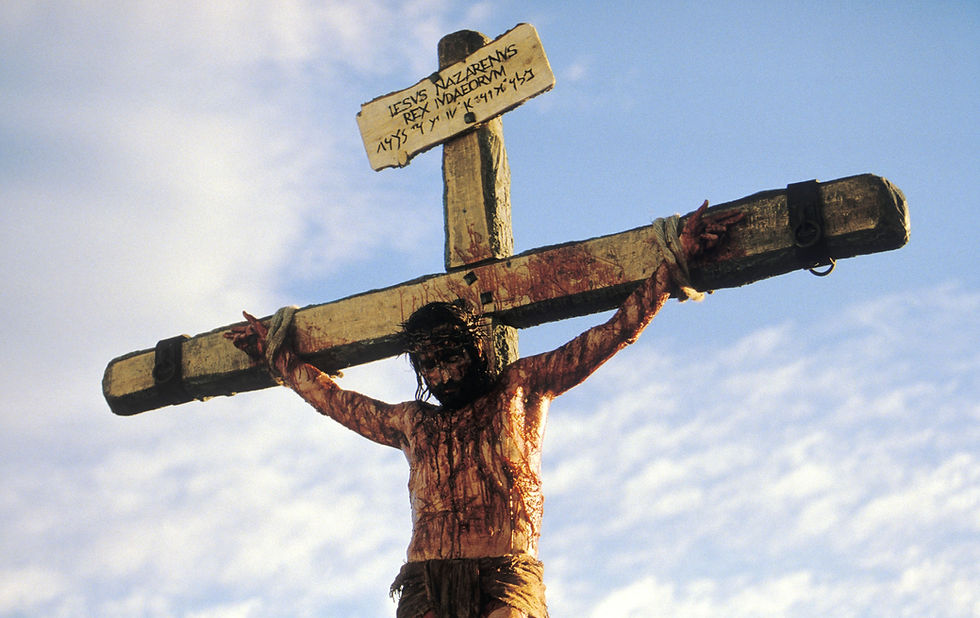
The crucifixion of Jesus stands as the ultimate expression of both human cruelty and divine love. Suspended between heaven and earth, His body nailed to the cross, Jesus endured not only excruciating physical pain, but also the profound spiritual weight of bearing the sins of the world.
Crucifision was designed to prolong suffering, making each breath a struggle, each moment an extension of agony. Even in the midst of this unimaginable pain, Jesus spoke words that reveal the very heart of God. He prayed for forgiveness for those who were actively crucifying him, extending grace in teh very moment of injustice. He offered hope to a dying criminal beside Him, demonostrating that it is never too late for mercy. Ultimately, He declared, "It Is Finished," signaling that the work of redemption had been fully accomplished. When He cried out in abandonment, it reflected the depth of what He was carrying, the separation from the Father that sin brings, now placed fully upon Himself. This was the turning point of all history, where sin was dealth with once and for all, and access to God the Father was amde open through His sacrifice.
Why This Is Personal
What makes all of this so deeply personal is the reality that none of it was accidental or unnecessary. Jesus did not suffer in general, He suffered specifically, intentionally, and personally. He knew every sin, every failure, every hidden struggle, every moment of weakness that would ever define our lives, and still, He chose the cross. This means that when we look at His suffering, we are not just seeing what happened to Him, we are seeing what He carried for us. The cross confront us with the seriousness of sin, but it also overwhelms us with the depth of god's love. It tells us that we are more broken that we often realize, yet more loved than we every imagined. For the believer, this changed everything. Our identity is no longer rooted in performance or failure, but in the finished work of Christ. We are not striving to earn love, we are responding to a love that has already been fully given.

A Call To Salvation
If you have never personally responded to what Jesus has done, this is your invitation. The Cross was not just an event in history; it was a personal act of love directed towards you. You do not need to fix yourself before coming to Him. You do not need to have everything figured out before you seek Him. The only requirement is a willing heart.
Scripture tells us that if we confess with our mouth that Jesus Christ is Lord and believe in our heart that God raised Him from the dead, we will be saved. This is not about religion, it is about relationship! It is about receiving what has already been done on your behalf.
You can come to Him right at this very moment!
If you are desiring Jesus fully into your after reading what He did for your sins, I want to ask you read this prayer below and really reflect and take your time reading it and praying to Jesus. Your life, Brother or Sister, is going to change forever!
Closing Prayer
Jesus, I cannot fully grasp the depth of what You endured, but I know that You did it willingly for me. You saw my brokeness, You saw my sin, You saw me i my weakness, and yet You chose the Cross anyway.
I confess that I have sinned against You. I admit that I have tried life on my own terms for far too long. But today, I want to turn towards You and away from my old self. I believe that You died for me. I believe that You rose again. I asked to receive Your forgiveness and Your Grace.
Be my Savior, Lord, and lead my life from this day forward.
Teach me to walk in the love You have show me. Teach me to live in the freedom You paid for me.
Jesus, thank You for the Cross and for being willing to love me this deeply.
In Your Name, Jesus, Amen.
Application
Take time to intentionally medidate on teh crucifixion accounts, not rushing through them, but allowing each moment to settle deeply into your heart. Let gratitude become specific; thank Jesus not just generally, but for thea actual suffering to prove yourself to God, and instead, begin to walk in the freedom of knowing that the price has already been paid. There is nothing you can do in performance to earn it. Let the reality of the cross shape the way you live, the way you love others, and the way you see yourself.
Reflection Questions
When you truly slow down and consider the suffering of Jesus, what stirs in your heart most deeply?
In what ways do you relate to Peter's denial, and how does that shape your understanding of grace?
Have you been living as though you need to earn God's love, or resting in what Christ has already finished?
Conclusion
When we truly behold Jesus in His suffering, something within us is awakened. The Cross is no longer distant or abstract, it becomes the very foundation of our faith and the anchor of our hope. It humbles us, reminding us of our need, but it also lifts us assuring us of our worth in God's eyes. This is the love of Christ, unrelenting, sacrificial, and deeply personal. Once you see Him clearly, you can never be the same again.